I've been working for 15 years, half of which remotely, and I've had to learn a few things.
Working remotely or in an office isn't really that different, except for the obvious advantage of being in person. The advantage being the socialization in real life, which no virtual meet up will ever compare to. As for the work itself, a lot of it can be replicated in both settings if you're someone whose work is mostly digital, like software developers, marketers, analysts, RevOps folks, etc.
Remote work, office work? What matters is deep work.
The setting is less important than the type of work we're doing. Indeed, remote work is still work. We all still need to ensure we're productive, collaborate effectively with our teams, and actively invest in our growth.
More importantly, we must hold ourselves accountable for getting enough deep work,
"Deep Work: Professional activities performed in a state of distraction-free concentration that push your cognitive capabilities to their limit. These efforts create a new value, improve your skill, and are hard to replicate."
as opposed to shallow work.
"Shallow work: Non-cognitively demanding, logistical-style tasks, often performed while distracted. These efforts tend to not create much new value in the world and are easy to replicate."
Both definitions are written by Cal Newport in his book "Deep Work", first published in 2016.
Reading "Deep Work" really made an impression on me. Part II reads as a tutorial and if you don't want to read the whole thing (it's a short book anyway), I completely recommend you read "The Rules" in Part II. Book or audiobook, whatever works for you.
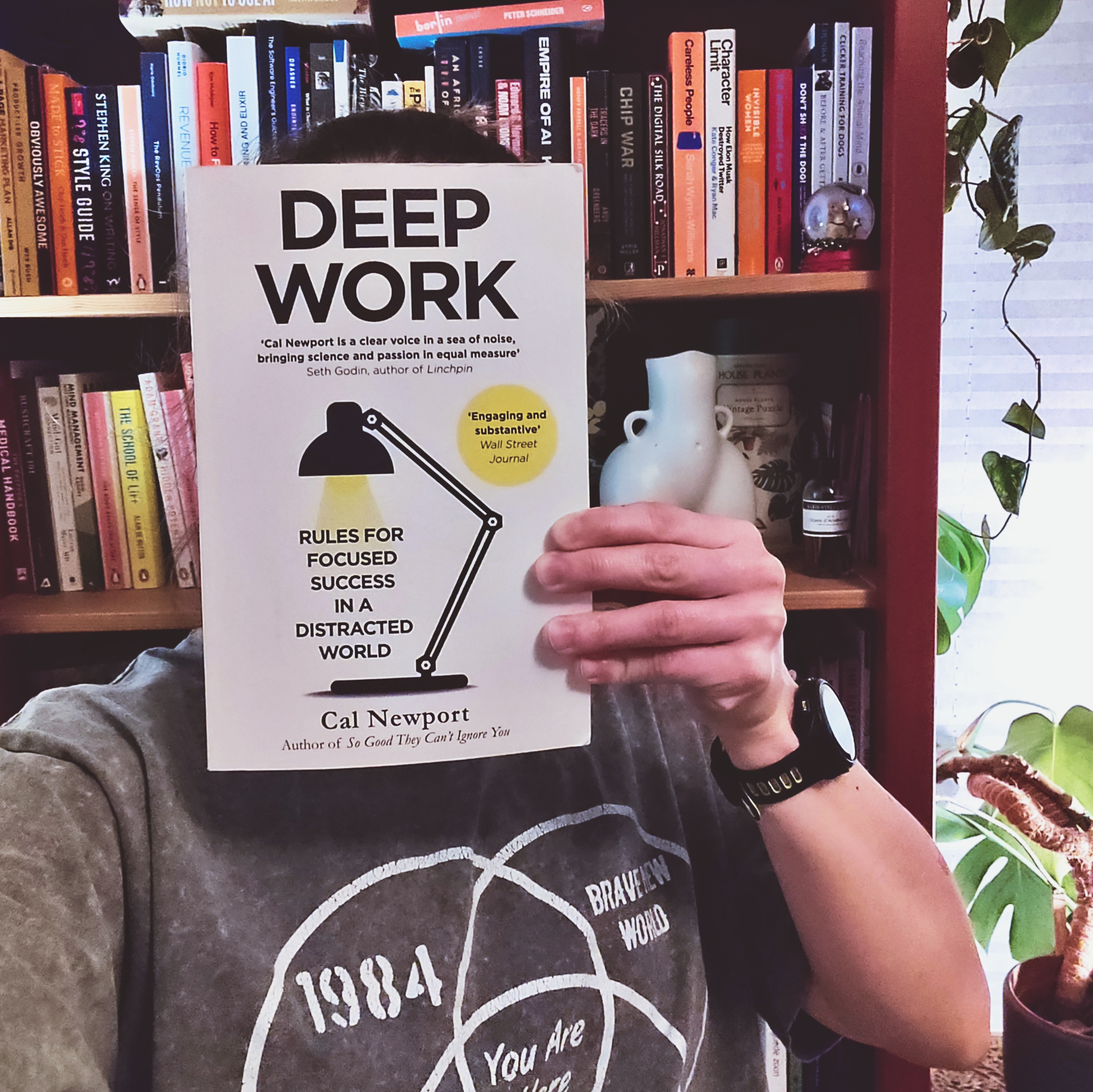
In this blog post, I'm sharing a collection of techniques I've been using for myself that make a difference in my day-to-day, based on some of my learnings. At the bottom of this post, I also share a list of resources on this topic.
First, the environment
Working in an office, home, co-working space, or somewhere else is not as important as designing a distraction-free environment, and drawing healthy boundaries that preserve our energy and capabilities. For me, working from home is what works best. If you can do that better in a office, great. Whatever works.
"The key to developing a deep work habit is to move beyond good intentions and add routines and rituals to your working life designed to minimize the amount of your limited willpower necessary to transition into and maintain a state of unbroken concentration."
Cal Newport
Get yourself a door (if you can)
Stephen King writes about this in his memoir as an important thing for his prolific work. A physical door is better, but if not possible, a separation of some sort between the workspace and the rest of the house (and its people) is best.
"The close door is your way of telling the world and yourself that you mean business; you have made a serious commitment to write and intend to walk the walk as well as talk the talk."
Stephen King
Both my partner and I work from home, and when I moved in with him, he already had his own office, so I started working in the living room. It could have worked, except the living room and the kitchen were all in the same space. It was hell for me to focus whenever he'd come to grab a snack, or cook lunch. I ended up moving my desk to our small bedroom and now I have a door that creates distance from unwanted distractions.
I've found that noise-cancelling headphones can also be a decent substitute when the door isn't an option, as long as there isn't too much movement in the room.
Disable notifications
I disabled all notifications in my devices some time ago. The Social Dilemma and The Anxious Generation had that effect on me. Recommended, both are worth your time.
And yes, that includes work devices. I don't have notifications on my laptop. I don't get interrupted every time I get an email, or any time someone messages me. I check Slack and my inbox when I choose to, not when I'm notified.
If you're thinking your job is too important to take such a risk, I invite you to read this article of how a CEO can do exactly that while running a very successful company: Turn off all notifications.
"(…) over the past years, nothing has happened that made me consider turning notifications back on."
Job van der Voort
Our attention is one of our most valuable assets and its capacity is finite. That means that a choice on where you're spending it will happen either way. You should be the one choosing it.
For example: you can decide to check your inbox first thing when you start working, right after lunch and before closing the workday. You can choose to check Slack every two hours, or have dedicated time slots for Slack throughout the day, or open it whenever you're transitioning from a big task to something else. Create a system for yourself, try it out, iterate.
No more Slack
Well, well, well… this is all easier said than done. Now that you don't have notifications, you still feel the urge to check the apps more often than you'd like. It's a tricky thing and researchers have published extensively about this urge.
When we've trained our brains to reach for a tool the moment we feel any friction or boredom, it feels hard to let go of the habit. So creating friction layer here is my go-to, by making it harder to satisfy the urge to check notifications:
- deleted Slack from my phone — no more quick sneak-peek outside working hours
- close Slack on my laptop when I'm focusing on a task — the time it takes to load the app is enough to discourage me from opening it midway through another task (harder when Slack is part of said task, unfortunately)
- turn off my laptop when the day ends — it takes too long to turn it back on, especially with that never-ending Okta password, to just go in and check a Slack message
Again, easier said than done. I personally know I still spend way too much unnecessary time on Slack. There's work to be done on myself, I'm far from perfect, and this is hard.
Put phone out of sight
On a podcast with the psychiatrist Inês Homem de Melo, I learnt about this research that showed how our performance worsens when our phone is visible (when solving math problems or remembering words, for example). Even if we're not using it, even if the screen is face down, even if it's on silent mode! The mere presence of the phone makes our brain work harder to ignore it and that chips away at our capabilities. So, just get it out of the room or out of sight. If it's important to check it, create a system. Set a specific time for phone activity. For example: I sometimes leave it in the room because I need to use the authenticator app, but I keep if behind my laptop screen where I can't see it.
Then, the tool stack
Controlling our environment gives us more agency over the external factors that pull us away from our work. But we're also at the mercy of internal factors: how well we sustain our attention varies from person to person and it's shaped by personality, neurotype, energy levels, etc. Research shows that we can sustain deep focus for around four hours a day, which means that we will be working on shallow tasks during the rest of our working hours. Gloria Mark calls this shift between deep and shallow work "kinetic attention" which is more about our rhythm and less about a behavior fault. The argument here is not deep vs. shallow work. The argument here is purposeful vs. chaotic action. Setting up a process that gives us the power of choosing what type of work we're doing and when, instead of having it dictated by tools designed to capture our attention. These are the tools I chose that are helping me protect my attention.
The timer cube
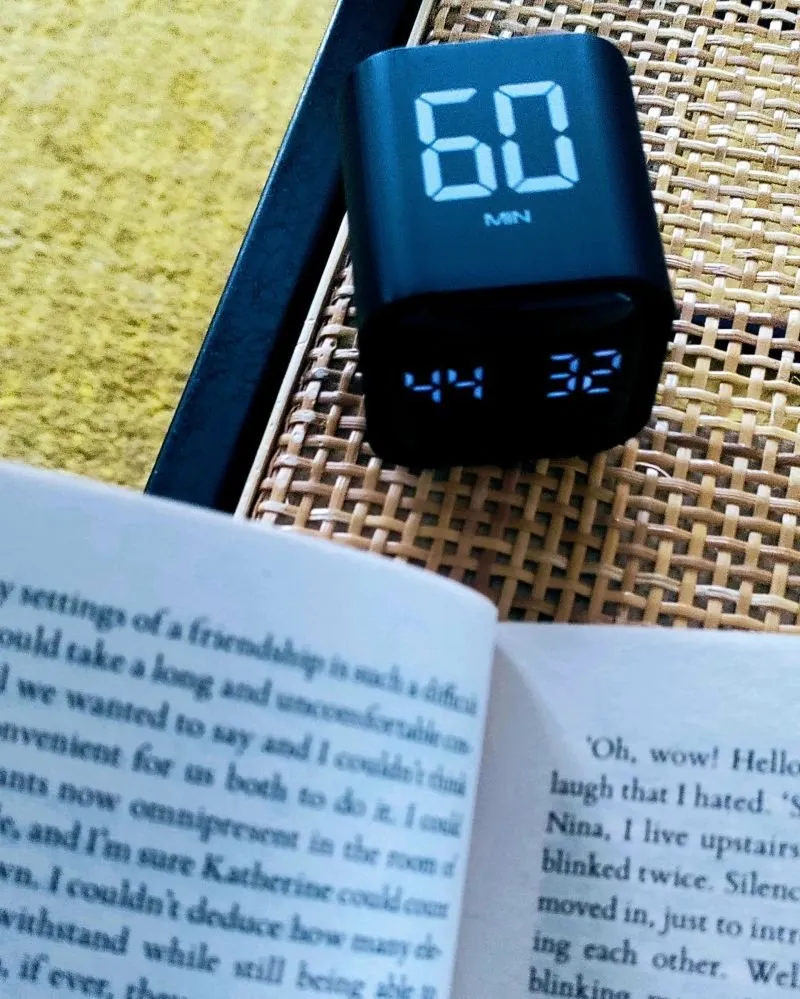
Now remember, when we're trained to distract ourselves whenever we're bored or have a hard task at hand, it is harder to remain focused for long periods of time. But it's a skill that can be trained. The more practice, the better. The old habit will not disappear, but it will weaken when a newer habit becomes strong. So, it's best to start smaller if longer blocks feel impossible.
When you do take a break, do something enjoyable like petting your dog, stretching, making a cup of coffee, reading a page of your current book. The reward is part of the practice, it's what reinforces the behavior.
Working a full day does not mean our brains need to be occupied with work during that whole time. Not only is taking a break okay, it's needed. Adam Grant dedicates a whole chapter, "Transforming the Daily Grind", to the importance of breaks to help you sustain the passion for your work. Taking a break reduces fatigue and raises energy, unlocks fresh ideas and deepens learning. It has even been shown that it can improve your memory by 10% to 30% with just a 10-minute break.
A notebook for doodling
Context switching is one of the most taxing activities during our workday. Gloria Mark shows in her research how shifting our attention frequently leads to higher blood pressure and elevated stress as measured by heart rate variability. This will translate into poorer performance because you're simply not using your full capabilities.
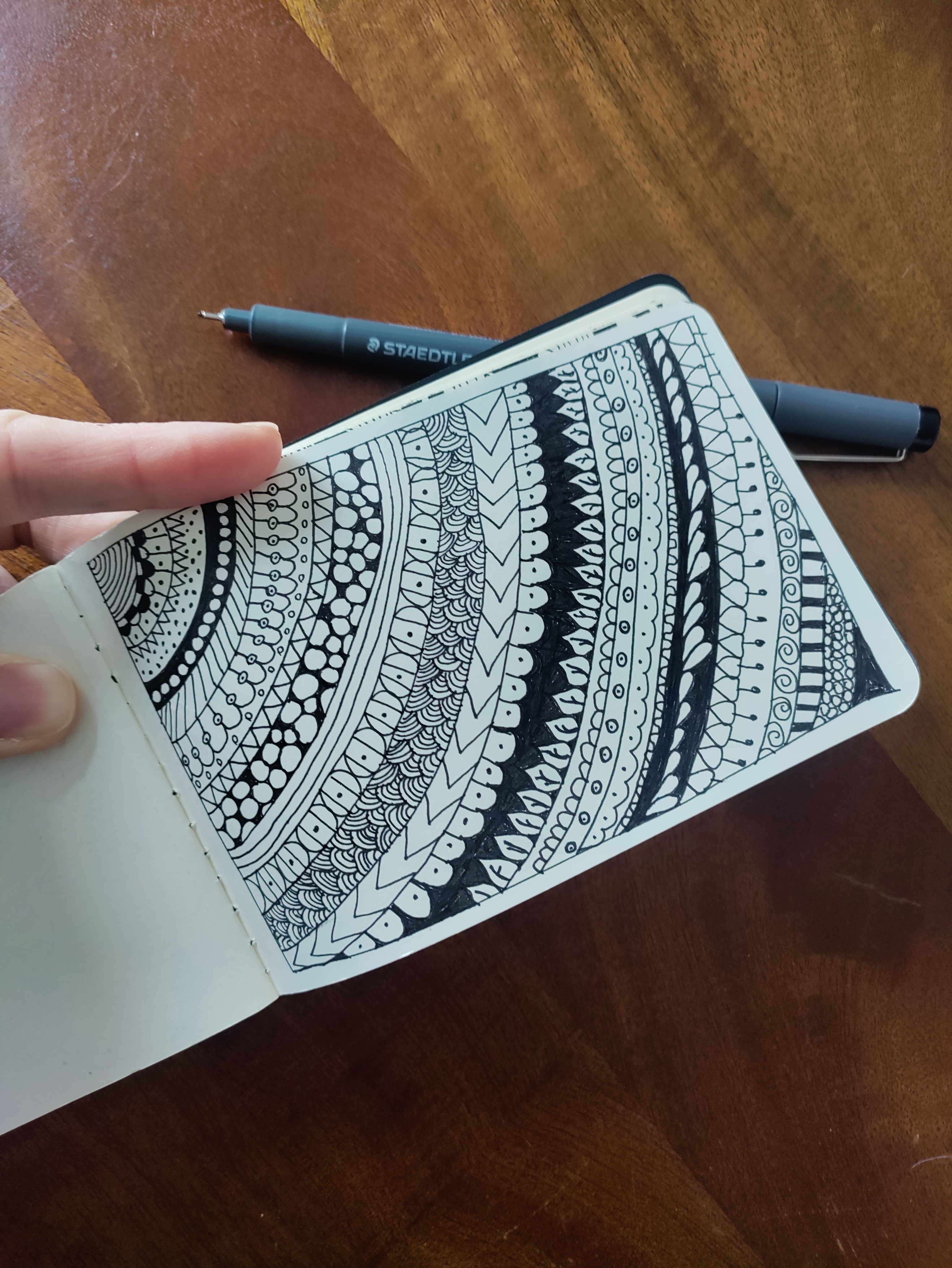
Truth is, multitasking is more often us switching context repeatedly than actually doing two things at the same time. Unless one of the tasks uses automatic attention, something you can do without too much thinking. Like doodling!
A stress ball
I can be fidgety when I'm in meetings. Especially in stressful seasons. I feel as if all my thoughts are running through my legs and hands and, more often than I'd like, rush to my mouth before it's my time to speak. I end up interrupting people and feeling bad for it.
Turns out having something in my hand to squeeze helps me restrain a bit better. All that pent-up energy gets concentrated on those hand squeezes, and I can focus on my breathing and listening skills.
It's still a work in progress. But better is better.
Good is good enough
What matters is how much of our day we spend doing work that actually pushes our abilities, and how much of it we spend reacting, switching, and catching up.
What matters is how much we control our own environment, and how much of it is controlled by external factors.
What matters is how often we come back to our healthier habits, and not how many times we've failed to follow through.
What matters is that we learn to feel bored again, to go offline again, to sit with the discomfort of a brain that's used to being constantly entertained.
What matters is that we're kind to ourselves. Technological evolution happens at a much faster rate than our brain's evolution, and it's genuinely hard for us humans to adapt to so much rapid change.
Embrace the boredom, for thus ideas are born.
Resources
- Book: Newport, C. (2016). Deep Work: Rules for Focused Success in a Distracted World. Grand Central Publishing.
- Book: King, S. (2000). On Writing: A Memoir of the Craft. Scribner.
- Documentary: The Social Dilemma (2020). Directed by Jeff Orlowski. Netflix.
- Book: Haidt, J. (2024). The Anxious Generation: How the Great Rewiring of Childhood Is Causing an Epidemic of Mental Illness. Penguin Press.
- Article: van der Voort, J. (2026, January). Turn off all notifications. Equity and Entropy.
- Podcast: Magalhães, T. (Host). (2024, July). #65 Inês Homem de Melo — PHDA, Vício, Gambling, Psiquiatria, Psicologia, SNS, Gaming. Despolariza.
- Article: Ward, A. F., Duke, K., Gneezy, A., & Bos, M. W. (2017). Brain drain: The mere presence of one's own smartphone reduces available cognitive capacity. Journal of the Association for Consumer Research, 2(2), 140–154.
- Book: Mark, G. (2023). Attention Span: A Groundbreaking Way to Restore Balance, Happiness and Productivity. Hanover Square Press.
- Book: Grant, A. (2023). Hidden Potential: The Science of Achieving Greater Things. Viking.